
Six-Roller Grist Mills

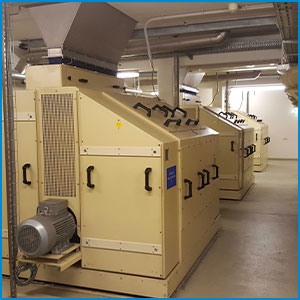
Six-roller malt mill for precise grist fractions

Six-roller grist mills serve brewhouses from 1,000 to 14,000 kg/h. In the Künzel six-roller mill, an intermediate screen between each pair of rollers results in particularly precise fractionation, and the husks can be separated from the grist and mashed in separately. Control is carried out via a programmable electronic control system with Profibus for integration into a supervisory process control system.

Key facts

  • Optimal grist composition as the basis for the enzymatic digestion in the mash
  • A brewery-specific mill can reduce malt consumption by as much as 10%
  • Very robust construction and long service life
  • High operational reliability and low maintenance costs
  • Intermediate screening to adjust and secure an optimal grist composition
Künzel models and capacities

Series A 20

  • A 20/30: 800 to 1,000 kg/h
  • A 20/40: 1,400 to 1,800 kg/h
  • A 20/60: 2,200 to 2,700 kg/h
  • A 20/80: 3,000 to 3,600 kg/h
  • A 20/100: 3,800 to 4,500 kg/h

Series E 25

  • E 25/80: 4,000 to 5,200 kg/h
  • E 25/100: 5,400 to 6,500 kg/h
  • E 25/125: 6,700 to 8,000 kg/h
  • E 25/150: 8,000 to 10,000 kg/h

Series F 25

  • F 25/125: 10,000 to 12,000 kg/h
  • F 25/150: 12,000 to 14,000 kg/h

Additional information

  • Intermediate screening between each pair of rollers, which results in particularly precise fractionation
  • Separate the husks from the grist and mash them in separately
  • Control is carried out via a programmable electronic control system with Profibus for communication with and integration into a supervisory process control system

data sheet

send inquiry

Two, four or six rollers: which grist mill fits your brewery?

  • Two-roller mills (250 to 500 kg/h): one pair of rollers crushes the malt in a single pass, the robust choice for brewpubs, craft breweries and pilot plants.
  • Four-roller mills (400 to 3,000 kg/h): two passes, with intermediate screening between the roller pairs depending on the model, for an optimal grist composition and better lautering.
  • Six-roller mills (1,000 to 14,000 kg/h): screening between each pair of rollers for particularly precise fractions; the husks can be separated and mashed in separately.

proBrau is not tied to one manufacturer: we source grist mills from Künzel, Engl, Bühler and Täuber and recommend the mill that fits your brewhouse and your capacity.

For a complete grist preparation, combine the mill with grain and malt handling such as malt intake, cleaning, weighing and malt conditioning screws. Malt houses, farmers and distilleries producing their own malt will find the Kaspar Schulz drum malting system here as well.

What good milling has to achieve

Milling crushes the malt and prepares it for mashing, the first step of the brewing process. The most important requirements are:

  • crushing of the grain to the desired particle sizes
  • a constantly low proportion of flour
  • maximum protection of the husk structure
  • the possibility of husk separation
  • adaptation to varying malt qualities

The classic dry milling process meets these requirements to an extremely high degree. Most of the largest breweries in the world use it for their lauter tun brewhouses, mostly complemented by upstream conditioning of the malt.

Request a quote for your grist mill